
04 – Wayfinding Workshop
- 22 nov. 2023
- 2 min de lecture

Informed by valuable insights garnered from industry interviews, we embarked on a workshop aimed at crafting a personalized wayfinding language. Our methodology involved dividing participants into two teams, each assigned to identify and designate five landmarks in distinct areas—Brick Lane and the Barbican Centre. The challenge was to develop unique wayfinding systems utilizing basic materials such as post-it notes, markers, and stickers. The teams then exchanged locations, attempting to guide each other to the specified landmarks. The sole restrictions imposed were a prohibition on using text and arrows in the devised systems.
Within the workshop, teams showcased diverse approaches. While one team meticulously crafted extensive maps, providing comprehensive guidance, the other adopted a more unconventional 'breadcrumb' strategy. This approach utilized stickers to chart a predetermined route, presenting a unique set of challenges for the opposing team. Despite the differences in strategy, a few commonalities emerged:
The adoption of 'hot and cold' signposting to convey direction, often employing color-coded elements


Visual representations of immediate landmarks for enhanced recognition.


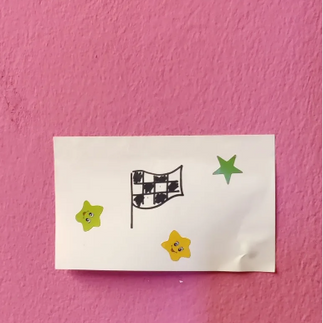


Inclusion of collectible hints along the route to reassure teams they were on the correct path.
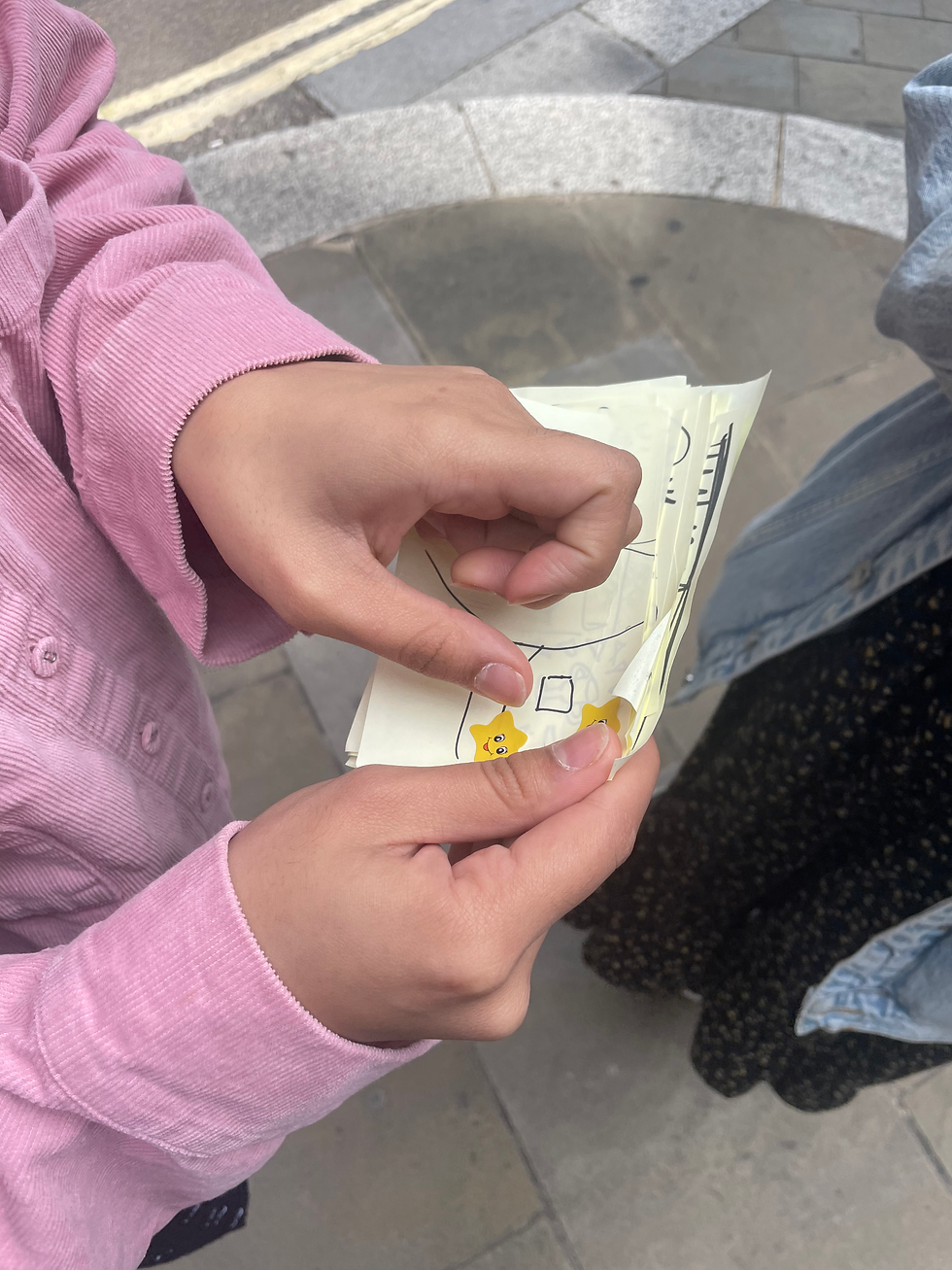
Post-workshop interviews provided valuable insights, with teams concurring that the 'collectible breadcrumb' strategy was the most effective. While one team initially expressed some frustration at receiving minimal guidance, they acknowledged the difficulty in discerning hints amidst the visually dense environment of Brick Lane, where stickers and wall art were abundant. This realization sparked intriguing reflections on the dichotomy between route-based and location-based wayfinding, a concept critical in urban settings and potentially challenging the prevalence of GPS tools.
The ensuing discussions led to a deeper conceptual exploration, contemplating the effectiveness of strategies in navigating through visually complex urban environments. The dichotomy between route-based and location-based wayfinding emerged as a central consideration, with implications for urban navigation, especially in scenarios where GPS tools might be replaced. The workshop proved instrumental in shaping our understanding of effective wayfinding systems and prompted thoughtful reflections on the complexities inherent in urban navigation.
Looking ahead, potential refinements to the workshop included limiting materials to discourage overly literal approaches and focusing exclusively on busier environments. These adjustments aimed to inspire more innovative solutions and enhance the workshop's effectiveness. As a crucial milestone in our research process, the workshop's outcomes, feedback, and conceptual considerations have significantly contributed to refining the direction of our project and deepening our understanding of the intricate dynamics of wayfinding in complex urban settings.


Commentaires