
5- Update on itirations
- 22 nov. 2023
- 3 min de lecture

In this crucial week, we seized the opportunity to gather feedback on the progress of our project. To enhance our presentation, we elevated some of our initial sketches into higher-fidelity prototypes, aiming to convey our ideas more effectively. At this juncture, our envisioned outcome crystallized: a digitally-augmented compass tailored for new residents, guiding them between carefully chosen points. At each juncture, scanning an object would trigger a voice recording from a long-term resident, sharing captivating stories about the location.
Exploring alternative navigational concepts, including the whimsical idea of a stuffed toy, we ultimately gravitated towards the skeuomorphism inherent in a digital compass. This decision was grounded in a few key considerations:
Preference for Location-based Wayfinding: We found location-based wayfinding more compelling than predefined routes, providing an accessible entry point for discussing subjective local stories.
Explicit Rejection of Existing Technologies: The compass, as a more overt rejection of existing technologies, resonated with our project's themes and goals.
Emphasis on Storytelling: Storytelling emerged as a crucial element, aiming to draw participants into an experiential acknowledgment of the subjectivity inherent in recreating spaces.
Simultaneously, we began outlining rough wireframes for a website/app, allowing users to contribute their own stories—a concept inspired by insights from David Kopulos. Recognizing the need to enable the project's self-sustainability, we deliberated on building a point to step away from direct involvement.
We also meticulously prepared a potential project completion timeline, including two buffer weeks at the term's end for essay work or any outstanding project tasks.
Feedback during the presentation prompted valuable insights:
De-centering Digital Platforms: If our project is positioned as a radical reimagining of navigation post-GPS, featuring an app or website might dilute our central message and needs reconsideration.
Strength of the Physical Metaphor: The compass emerged as a robust physical metaphor, emphasizing the potency of the design's physical aspects.
Audience Refinement: A need to narrow down our audience from the broad category of 'tourists' to a more specific and reachable group.
Incentivizing Resident Contributions: Ensuring there is a compelling incentive for long-term residents to actively contribute to our project.
Earlier itirations
In considering alternative directions for our project, the initial notion of using a stuffed toy emerged from a personal interest in exploring unconventional ways for new residents to navigate London. Early sketches depicted tourists employing a cuddly toy as a navigation tool, injecting an element of playfulness and comfort into the exploration of the city. This concept aimed to provide a novel and reassuring approach, particularly considering London's mixed safety reputation.


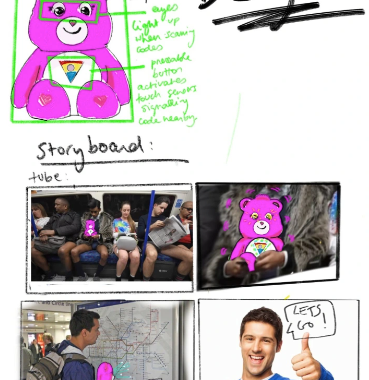
Reflecting on this idea as an example of some of the discussions shared with my project partner, we contemplated using a Care Bear, leveraging its existing button for sound generation. However, discussions revealed concerns that the bear might overshadow the navigation aspect, drawing too much attention to the tool itself rather than the immersive experience. Subsequent iterations explored more conventional options, like a discreet wearable bracelet, but ultimately, we opted for the antiquity and skeuomorphic quality of the compass as the superior choice.
Reflection
Despite geographical challenges, our collaboration successfully maintained a strong rhythm of communication and task tracking. Early tensions between preserving the wayfinding element and exploring creative avenues enriched our considerations, contributing to the refinement of our chosen concept—a digitally-augmented compass for tourists navigating London's diverse landscape. This decision aligns with our commitment to pushing the project beyond traditional productization, striking a balance between artistic exploration and resisting capitalistic orientations.


Commentaires